“I ran $15 billion at Fidelity Magellan and the single biggest lesson I can give you is this: the price you pay is the only thing that determines whether you make money or lose money over time. Everything else is noise.” – Peter Lynch, legendary fund manager
Stock market investing is an area where the midwit meme always seems to apply:
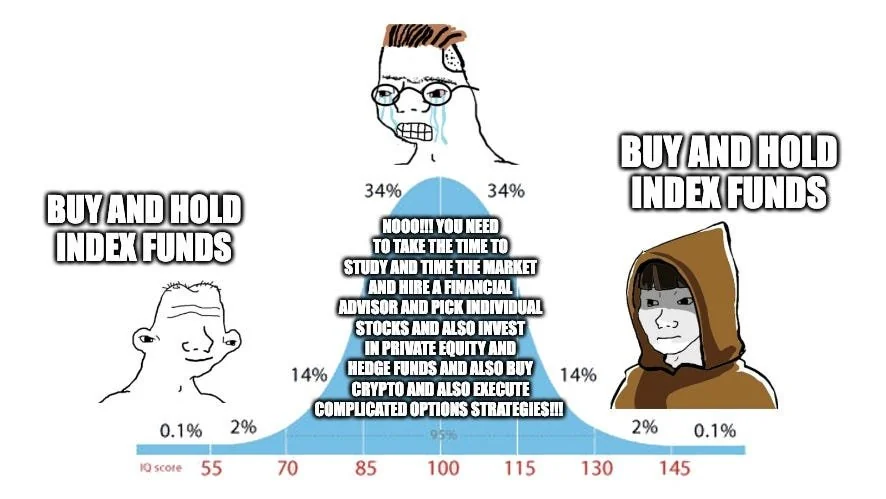
So for years, I obediently filled my pension with a global index fund and went on with my life – just as we’re told to.
And yet…
When I was researching my book Seven Myths About Money, I came across too much evidence to ignore suggesting that while buying the index has been the killer move of the last decade, it’s going to massively disappoint anyone buying in today.
So I set about rebuilding my portfolio, with two aims in mind:
1: Invest in a way that I believe will beat a global index fund over the next 10-20 years
2: Still avoid active trading: “set and forget”, with no need to re-think every year
In this post I’ll share how I’ve done that, and how it’s going. But first, we need to dig into…
What’s wrong with index funds?
We’re lucky enough to live in a time when you can buy a simple global tracker fund: a single, cheap purchase that gives you a tiny slice of thousands of companies across the world.
The theory goes: most investors, including professionals, end up underperforming the global average over the long term. So why not just buy exposure to the global average and be done with it?
It’s brilliantly simple and compelling logic. But it’s also – in my opinion, and based on the evidence I’ve seen – wrong.
At least, it’s wrong from today’s starting point.
The curse of success
Global index funds are weighted – so you get most exposure to the biggest stock markets, and less exposure to the smallest. Makes sense: you wouldn’t want a random market crash in Vietnam to rock your returns when it’s insignificant in the overall global scheme of things.
This means that right now, you get the most exposure to the US. It varies by fund, but in the popular VWRL fund it makes up 63% of the total fund. (The second biggest weighting is miles behind: Japan, at 5.7%)
Again, this isn’t a flaw: the whole point of a global tracker is it’s as if you owned a representative sample of the whole world, and the US market is by the biggest.
But it does mean that your “global” returns are almost totally driven by what happens in the US. For example, here’s a chart comparing the performance of an S&P500 (the US market) tracker and a global tracker:
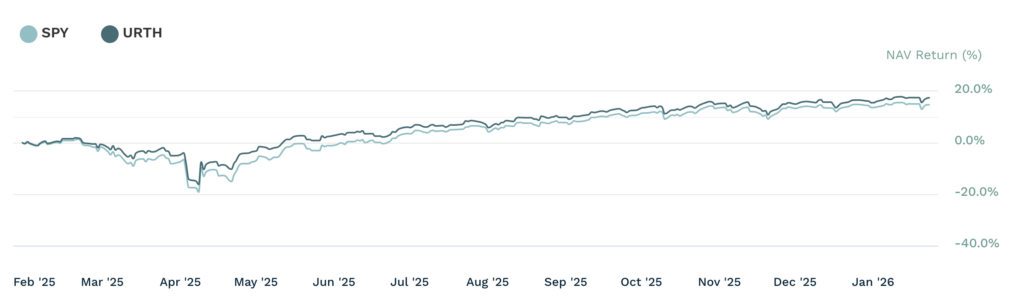
As you can see, they move in exactly the same way at exactly the same time, by almost exactly the same amount.
Again: not a fault. And in fact, over the past decade you would have been extremely grateful for that exposure: the US market has beaten the pants off everything else.
But therein lies the problem…
I wouldn’t start from here
What’s the biggest factor determining how well an investment will perform over the next 25 years?
You might think: success of the country, growth of the sector, quality of management, potential for innovation…
But no: according to research from Deutsche Bank, the biggest factor by far is the price you pay. In other words: are you buying in when something is cheap, or expensive?
A common measure of “cheapness” in stock market investing is the P/E ratio: the price of a company relative to its annual earnings. A P/E of 20 means you’re paying £20 for every £1 the company currently earns. The lower the number, the cheaper the investment is relative to its current earnings.
To pick two simplified examples:
– Company A has a P/E of 5
– Company B has a P/E of 20
If the companies were identical in every other respect, you’d rather buy Company A: you’re paying far less for each pound of earnings.
In reality, of course, they’re never identical. Company B might be expected to grow much faster, while Company A might be struggling or have unreliable accounts. But on average, paying a lower starting valuation has historically been associated with better long-term returns.
And that takes us back to our problem with the US.
Let’s look at the current P/E ratios of some different global markets (again, remembering that a lower P/E means cheaper relative to current earnings)
- UK: 19.4
- Japan: 16.9
- Europe: 16.7
- Emerging markets: 15.6
- US: 29.2
As you can see, the US is radically more expensive than anywhere else – and also, expensive in its own historical terms. It’s at around the same level as it was before the dotcom bubble, and before that it had never been this high.
That doesn’t mean it’s bound to crash. It just means it’s relatively expensive.
And remember: “expensive” normally means “poor long-term returns if you buy in at this level”.
Here’s a chart demonstrating exactly that:
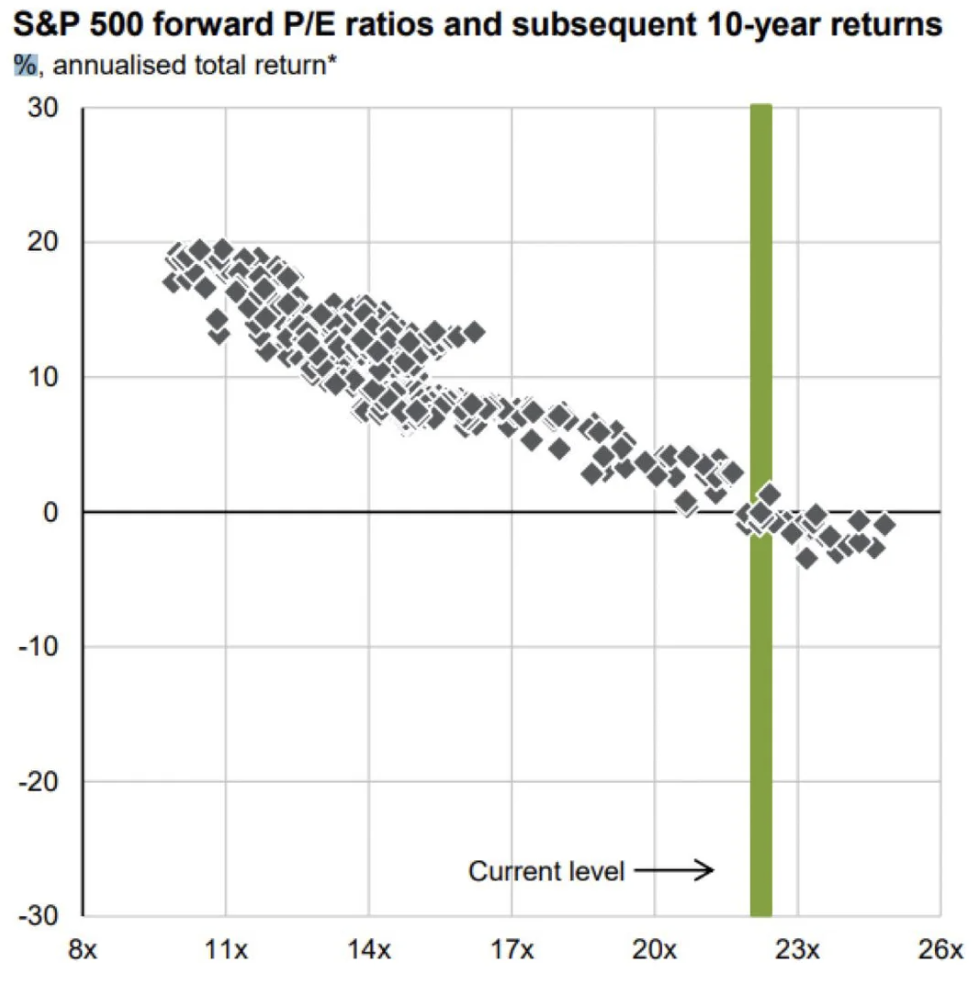
Right now you’d be buying around the green line, which means that based on historical data you’d expect your 10-year return to be… pretty much zero.
There are lots of subtleties and partial rebuttals to this, and many people will disagree with either the “US is expensive” argument or the “it’s worth trying to do something about it” argument. I know all the rebutalls, and I agree with some of them. But let’s not get waylaid by all that now – let’s keep it breezy and summarise:
- In the stock market, the biggest predictor of future returns is the price you buy in at
- The US is both relatively and historically expensive
- Global index funds give you exposure to majority US holdings (~63%)
Therefore: You’d expect the future performance of a global index fund to be low from here.
That was a compelling enough case for me to start looking for alternatives.
What I’m doing instead
Remember, my aim was to build a portfolio that’s nearly as set-and-forget as a global index fund, but which I believe is going to produce better future returns.
The way to do that in a nutshell: underweight the US, and start with more of what’s cheap.
Over time, prices will change and what’s cheap today might end up expensive – but they’ll change slowly, and I see these themes being in place for the next five years at the very least. Therefore I put together a portfolio that I thought I’d be able to not think about again for the next five years.
A few quick caveats before we get to the good stuff:
- I’m just sharing what I’m doing, not suggesting that you do the same
- I have more tolerance for thinking about this stuff than the average person
- As soon as you deviate from “average”, you open up the chance of being expensively wrong
I can afford to be wrong, and I’d rather be wrong than fail to follow what I intellectually believe to be true. But again, I’m not most people.
So finally, to the point:
My pension currently contains:
- 30% World Value fund (an index fund made up of cheaper companies globally)
- 8% Emerging Markets excluding China
- 10% frontier markets (AKA “less developed than emerging”)
- 8% UK FTSE All-share
- 12% S&P 500
- 32% non-equities (a subject for another day)
This isn’t quite as much as a tilt away from the US as it first appears: 42% of the World Value fund is made up of US companies.
What it is though, is a structurallycheaper portfolio:
- World value: 14.5 P/E
- Emerging markets: 18.7 P/E
- UK all-share: 17 P/E
Again, compared to the US market at around 30.
And it’s still dead simple to manage, because it’s just a handful of funds.
Is it working?
I made this shift around three years ago.
For the first two, it was a losing strategy. That’s to be expected: going against orthodoxy and underweighting the clear winner will inevitably make you stupid before it comes good (if it does).
But last year, it finally came good: I beat a US index fund by 15%, and a World index fund by 13.8% (again, see how similar those numbers are?)
That doesn’t mean it’s been a success. I won’t know that for many years yet.
But I feel like I’m meeting my twin goals of keeping things simple, while putting my money where my mind is.
And if Peter Lynch’s observation continues to hold true, I’ll be better off for it in the end.